Amino acids, like any other nutrient we ingest or produce, serve to form, enhance, and repair structures that we need to live. That’s why our crops also need them—a lot.
You already know we like to show the many similarities between plants and humans. As living beings, we have more in common than we might think. Amino acids are precisely one of those commonalities: both plants and humans need them. Why? Because they are molecules that function as the structural units of proteins and peptides, making them crucial to the life of all living beings, including plants.
Amino acids, like any other nutrient we ingest or produce, serve to form, strengthen, and repair structures that we need to live. And that’s why our crops also need them—and in large amounts. Methionine, L-arginine, L-alanine, L-glycine, and L-glutamic acid are among the most important for plants, which synthesize them from carbon, oxygen, and hydrogen
During spring, it makes even more sense to talk about amino acids, as they boost chlorophyll production and, therefore, are involved in regulating plant growth and development by facilitating the proper absorption of nutrients.
In summary, they act as essential energy agents for any plant species.
By participating in hormone synthesis and enzymatic reactions, their role throughout the plant’s life is highly necessary.
Additionally, they perform antioxidant actions and help plants mitigate the effects of stress caused by frost, extreme cold or heat, sudden temperature changes, and more.
The key point is that although plants naturally produce amino acids, the biochemical process is highly complex and energy-intensive. That’s why the application of biostimulant solutions containing amino acids can be very beneficial in certain circumstances, as it allows the plant to save energy to improve its development during critical stages of growth or abiotic stress.
The use of amino acids in agriculture is not new. Biostimulants containing amino acids play an important role in mitigating both abiotic and biotic stress in crops. They are composed of organic molecules obtained through various processes, such as enzymatic hydrolysis or fermentation, and depending on their composition, they can have different effects on the plant. Sometimes, plants may have great difficulty producing amino acids of the right quality and in the necessary quantity.
When do crops need amino acids?
In situations of biotic stress
These are key moments in the crop cycle, where plants can be seriously affected if no action is taken in time. This includes the post-transplant period, certain growth stages, flowering, fruit set, and fruit development.
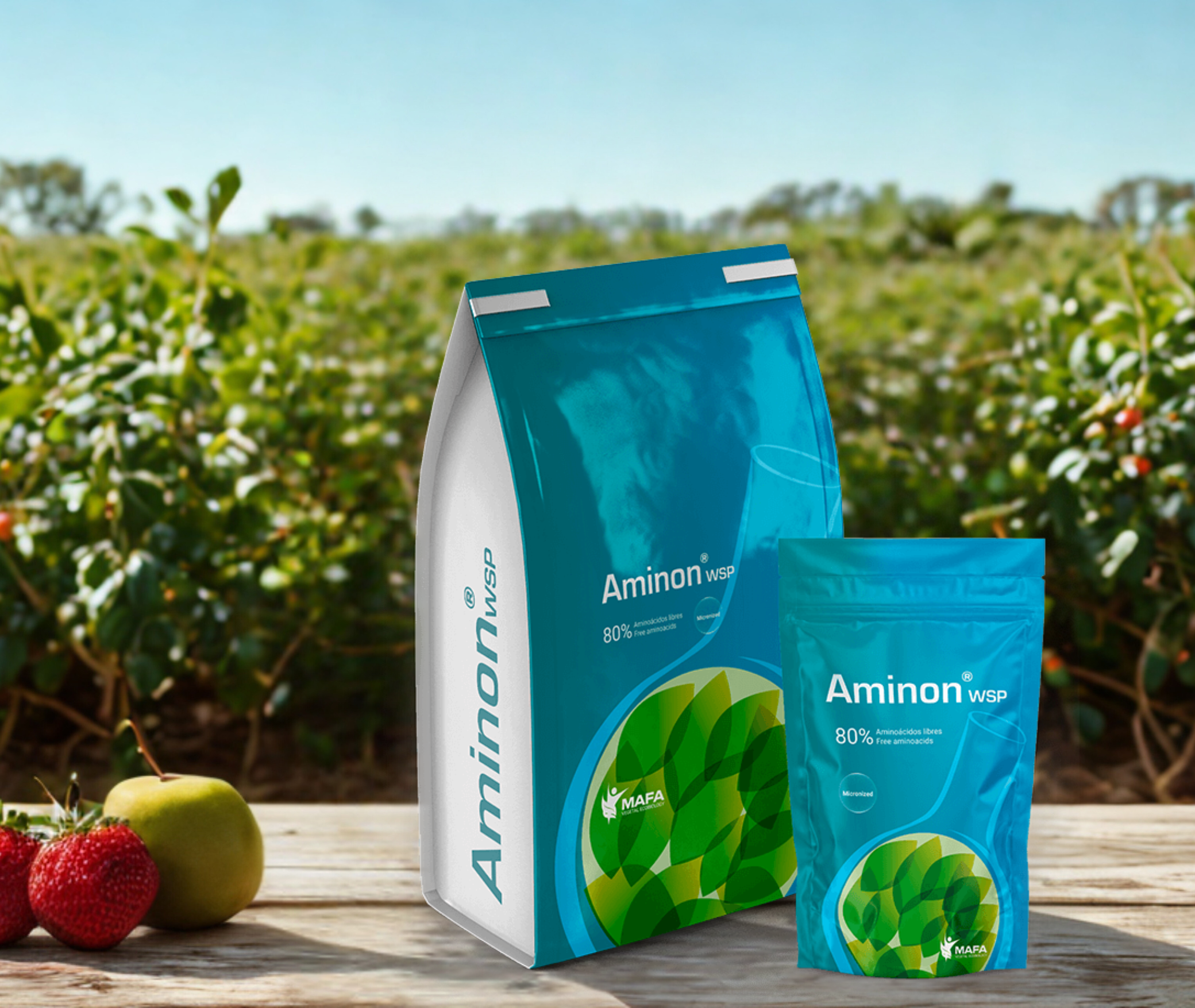
Using biostimulants like Aminon WSP is completely safe, as it is free from phytotoxicity and helps the plant improve its nutrition and manage the various sources of stress that affect its physiology.
In situations of abiotic stress
Adverse weather events, such as extreme cold or heat, flooding, drought, or episodes like hail or wind, call for the help of amino acids. In this way, plants can respond to all these situations that negatively impact their metabolism and can harm yield and quality.
For example, against high temperatures, amino acids promote the retention of water in the cytoplasm in higher quantities, while against low temperatures, they accumulate in the plant’s most vulnerable points. This allows for optimal recovery.
An extra dose of amino acids may also be required to prevent the effects of fungi, bacteria, viruses, nematodes, etc.
Salinity imbalance
When there are high concentrations of salts in the plant’s cells, amino acids like L-proline help protect the plant by retaining water. In other words, they assist in water absorption and help maintain the plant’s osmotic potential.
To improve the plant’s natural defenses and crop yield
Applying a biostimulant with amino acids greatly enhances the quality of the fruits while strengthening the plant’s natural defenses, enabling it to withstand attacks from pests, diseases, hail, heat waves, etc.
Among other benefits, this leads to a better sugar-to-acidity ratio (°Brix) in the plant, as well as increased fruit size and color.
To enhance the chelating effect
When applied together with micronutrients, amino acids make the absorption and transport of trace elements to the plant more effective. In other words, a plant with an adequate supply of amino acids can more easily absorb micronutrients that have low mobility, thanks to the chelating action we mentioned.
And how are amino acids applied?
The formulation of biostimulants is based on their versatility. Their mobility, solubility, and compatibility with other agricultural products make them easy to apply. They can therefore be applied alone or in combination with other products, either via foliar application or through the roots, depending on the specific objective.
For example, if the goal is to stimulate flowering or fruit set, it is recommended to apply the amino acid biostimulant directly onto the foliage. On the other hand, if the aim is to promote root system development, the best option is to apply it through irrigation.
As we can see, amino acids are like vitamins for our crops. The Aminon WSP product line addresses various needs through different biostimulant solutions